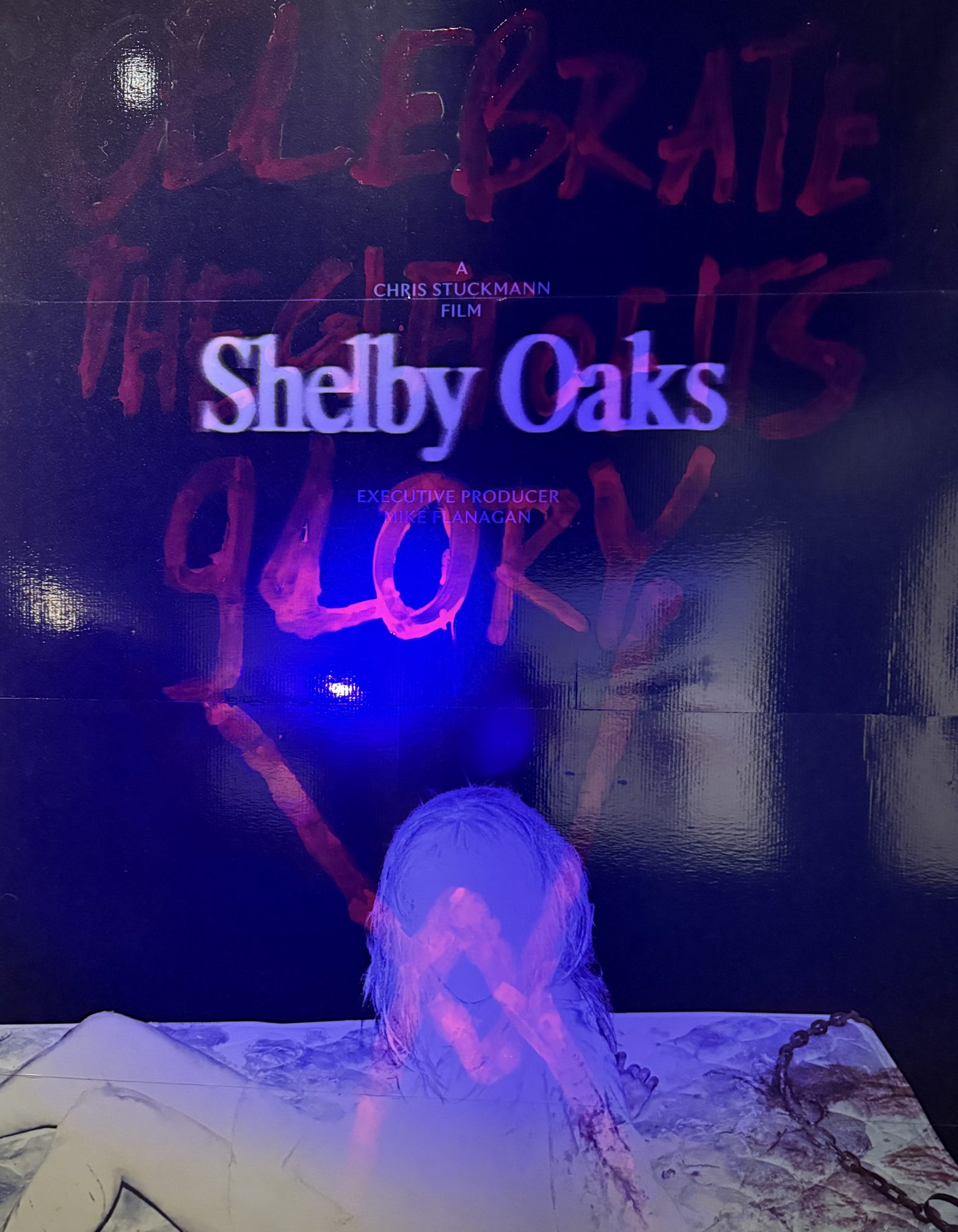
I entered Shelby Oaks at Fantastic Fest 2025 with fairly modest expectations — the premise sounded quite familiar, and I half-expected another typical horror mystery. Instead, I left surprised by how much the film stayed with me. It’s not perfect, but it’s smarter, eerier, and more emotionally grounded than I expected, with moments that truly unsettled me long after the credits rolled.
From the opening scenes, writer-director Chris Stuckmann builds a world that feels rooted in grief and obsession. We follow Mia Brennan, played by Camille Sullivan, whose sister Riley (Sarah Durn) disappeared years earlier while investigating paranormal activity with her YouTube ghost-hunting group, the “Paranormal Paranoids.” Mia has never accepted that Riley is gone, and her relentless search takes her deep into the strange, haunted corners of Shelby Oaks — and eventually into something far darker than she ever imagined.
Sullivan’s performance is the backbone of the film. She portrays Mia as someone teetering between determination and desperation, grounding the story even when the supernatural elements escalate. I believed her grief and guilt, which made the horror feel more personal. Brendan Sexton III adds grit as Robert, Riley’s former partner in both life and ghost-hunting, while Michael Beach (Detective Burke) and Robin Bartlett (Norma) lend weight in smaller but memorable supporting roles. The ever-reliable Keith David also appears briefly as Morton Jacobson, delivering a commanding presence in just a handful of scenes.
One of the things I appreciated most was how the film shifts gears. It begins as a documentary-style mystery, with interviews, shaky footage, and online fragments piecing together the sisters’ story. Then, without warning, it transitions into a more traditional narrative horror film. That structural shift could have been jarring — and it is, to some extent — but it also gives the story more emotional punch. Once Mia enters the heart of the mystery, we’re right there with her, watching her obsession blur the line between truth and madness.
Visually, Shelby Oaks is often striking. Cinematographer Andrew Scott Baird employs shadows, stillness, and subtle movement to build tension rather than relying on cheap jumpscares. Some of the most unsettling moments are the quiet ones — a door slowly opening on its own, a figure barely visible in a reflection. The scares are effective, but it’s the creeping sense of dread that truly lingers.
If the film has a weakness, it’s in the third act, where the mystery becomes a bit too spelled out. I found myself wishing for more ambiguity — the unknown is always scarier than the explained. Even so, the finale delivers tense, well-executed sequences and a satisfying emotional payoff that makes Mia’s journey feel complete.
Ultimately, Shelby Oaks isn’t just a horror story; it’s about how far someone will go for the people they love, even when the answers they seek might destroy them. I went in expecting something formulaic and came out impressed by how much more it offered. For a debut feature, Stuckmann demonstrates a confident hand with atmosphere and character, and I’m genuinely interested to see what he does next.