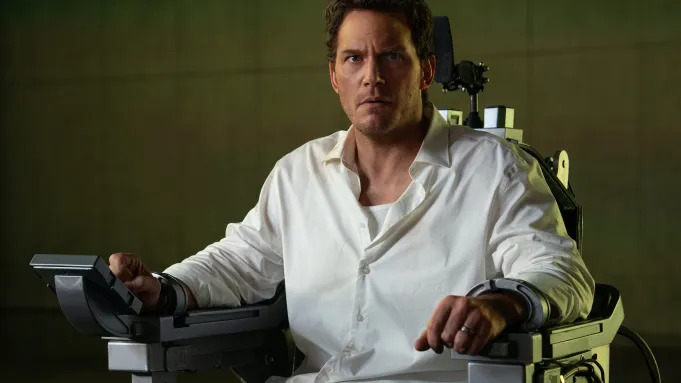
Look, I like what Chris Pratt has brought to comedic performances, especially in the Guardians of the Galaxy trilogy, but the actor cannot do serious drama. This fact is so starkly evident in a film already plagued by bad writing and direction, but it would have been a lead role that could have been so much better had it been given to a better actor with true range. Pratt simply does not have the star power or the acting chops to elevate the most ridiculous premise, and Mercy comes pretty damn close to that low level. It initially seems that this film and its filmmakers hoped to offer commentary on the state of technology (particularly AI) and the U.S. criminal justice system. However, the gimmicks employed in this film further make a mess of things, and it simply does not help that the lead protagonist is in the hands of someone who is not at all capable of selling whatever it is they are trying to sell.
Pratt stars as Christopher Raven, an LAPD police officer going through some serious trauma, along with alcoholism and the resulting fallout that affects his family. The film begins with Raven awakening in a chair, locked down for a virtual trial. He is being charged with the murder of his wife, but cannot seem to remember how he got there. The year is 2029, and the LAPD has implemented a new criminal justice program called Mercy, in which people charged with a crime go to a virtual trial presided over by an AI judge named Judge Maddox (Rebecca Ferguson).
After Raven gets his bearings straight, he must defend himself, despite the electronic evidence working against his case. Christopher has limited time to comb through the evidence and prove his innocence. The evidence used by Judge Maddox to pronounce a verdict and execute the defendant consists of video, text messages, phone calls, and other electronic footprints.
The film borrows heavily from science-fiction movies like Minority Report, but fails to justify its own existence with any substantive ideas. Its flaws—poor cinematography, weak script, lackluster direction, and an underwhelming lead performance—seriously undermine its quality.
With all of this movie’s bewildering choices, I honestly don’t know what point the filmmakers are trying to make. Director Timur Bekmambetov and writer Marco van Belle seem to want to critique our criminal justice system, our reliance on technology, and the problems associated with artificial intelligence, but given the story’s conclusion, it does none of the above.
The film is marred by laughable sequences and absurdity, so I could not take the story’s scenarios seriously. As entertained as I was by the absurdity of the filmmaker’s choice, Mercy doesn’t even qualify as “so bad, it’s quite comedic.” I attended a 3D, IMAX screening of the movie, and there honestly is no need to present this film in those formats. I cannot recommend it at all.