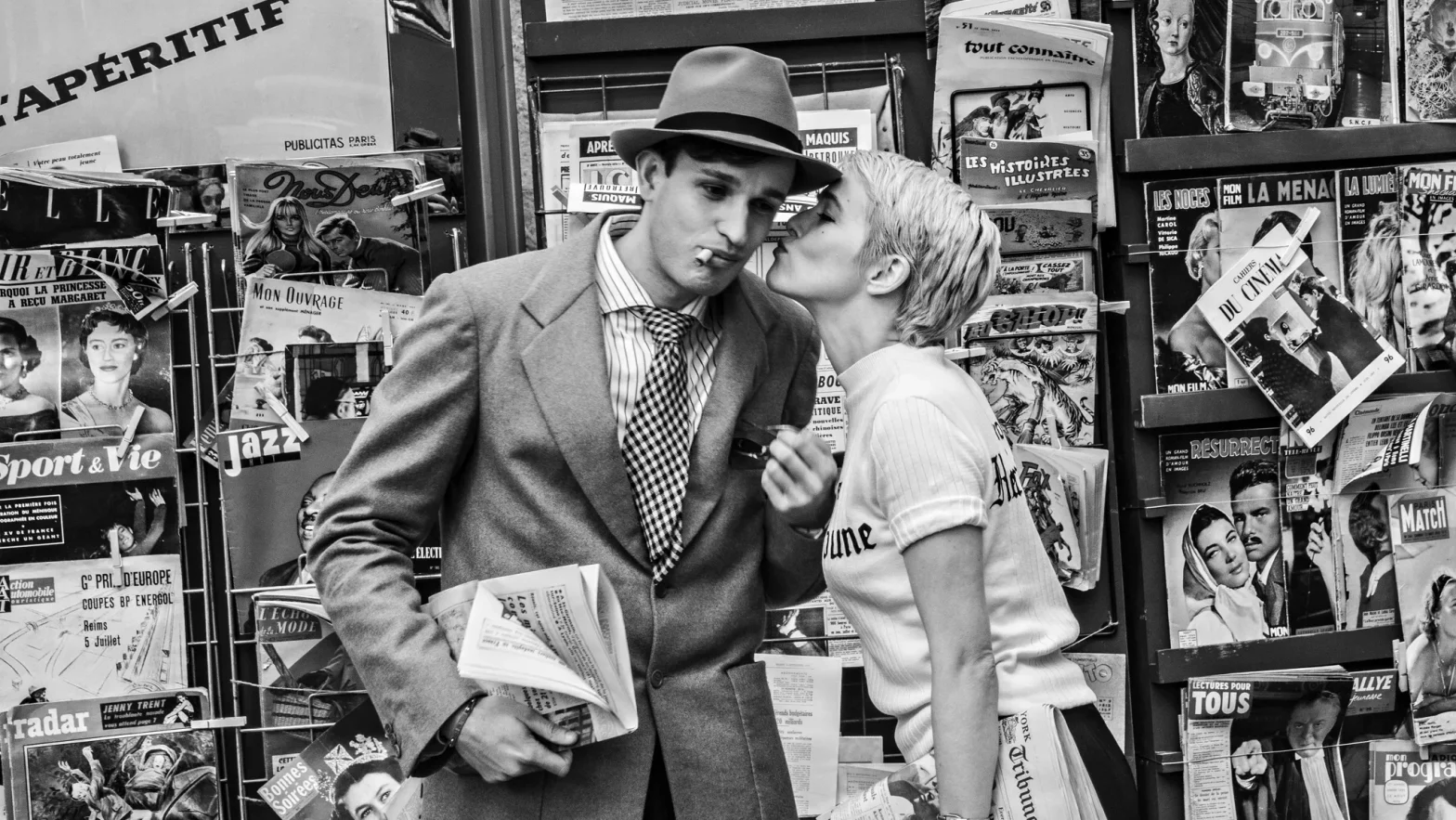
From 1958 to the 1960s, a film movement in France, known as the Nouvelle Vague (French New Wave), had a significant impact on the world of cinema, forever influencing arthouse and independent film. One particular filmmaker who was greatly affected by the movies of this movement is Richard Linklater. Some of the filmmaker’s dialogue-driven, “hang-out” films, such as Slacker, Dazed and Confused, and the Before Trilogy, are definitely influenced by the French New Wave, particularly the films of Jean-Luc Godard. It seems that Linklater owes a debt of gratitude to this iconic era of French cinema, and pays that debt with a tribute to one of the all-time classics of the movement, Godard’s Breathless.
With Linklater’s newest film, Nouvelle Vague, the director and crew skillfully recreate not just the making of the film, but also the entire movie scene, portraying Godard as well as Francois Truffaut, Agnès Varda, and several of Godard’s contemporaries and mentors. The film is both a portrait of a filmmaker’s debut and a loving tribute to the rise of a film movement that brought several legendary directors to prominence.
Guillaume Marbeck stars as film critic and aspiring filmmaker Jean-Luc Godard. In 1959, after watching his dear friend Francois Truffaut’s (Adrien Rouyard) career take off with his breakthrough film, The 400 Blows, Godard feels ready to make his big splash in the Nouvelle Vague scene. He has never before directed a feature-length movie, but this doesn’t stop the 29-year-old from taking on the challenge. Inspired by a French true crime story and equipped with a camera, as well as a small cast and crew, Godard goes on to make an indelible mark with his unique art film. He faces pushback during the making of the film from his producers, cast, and crew, all of whom are bewildered and frustrated by his unorthodox methods and inconsistent shooting schedules.
As someone who loves French New Wave films, I was thrilled to see this. Breathless is one of my favorite Godard films, so I could not wait to experience Linklater’s reenactment of its creation. The art and set design, cinematography, and use of CG effects to recreate the time and place make the film’s look impeccable. I was blown away by how closely the film resembles Breathless.
Besides the aesthetics of the movie, I was genuinely immersed and engrossed by this iconic world and time period when boldly creative film artists revolutionized arthouse cinema. Linklater and screenwriters Holly Gent, Vincent Palmo, Michèle Halberstadt, and Laetitia Masson create a film and develop characters that are striking and fun to watch. Linklater and his team have essentially made another hang-out movie, mostly driven by dialogue, and as usual, it results in magic. The film features outstanding performances by Guillaume Marbeck, Zoey Deutch (who portrays Jean Seberg in Breathless), Aubry Dullin (who plays Jean-Paul Belmondo in Breathless), and a large ensemble of French actors superbly cast as other film icons.
I love that the movie is mostly in French, with English snippets throughout. This might not appeal to those who dislike foreign language films with subtitles. Then again, if that describes you, this story probably won’t interest you anyway. Having the film in French gives it a natural, organic authenticity. It would feel rather lame if the whole film were in English, with actors using French accents.
It should now be clear that I absolutely loved this film and highly recommend it, especially for cinephiles who admire the French New Wave and fans of Linklater. While the visual style is notably different from his usual approach, the writing and direction remain unmistakably Linklater. The film imagines Linklater as an American director shaped by the Nouvelle Vague, as if he were a contemporary of Godard. Since the movement greatly influenced Richard’s career, this comparison is fitting.