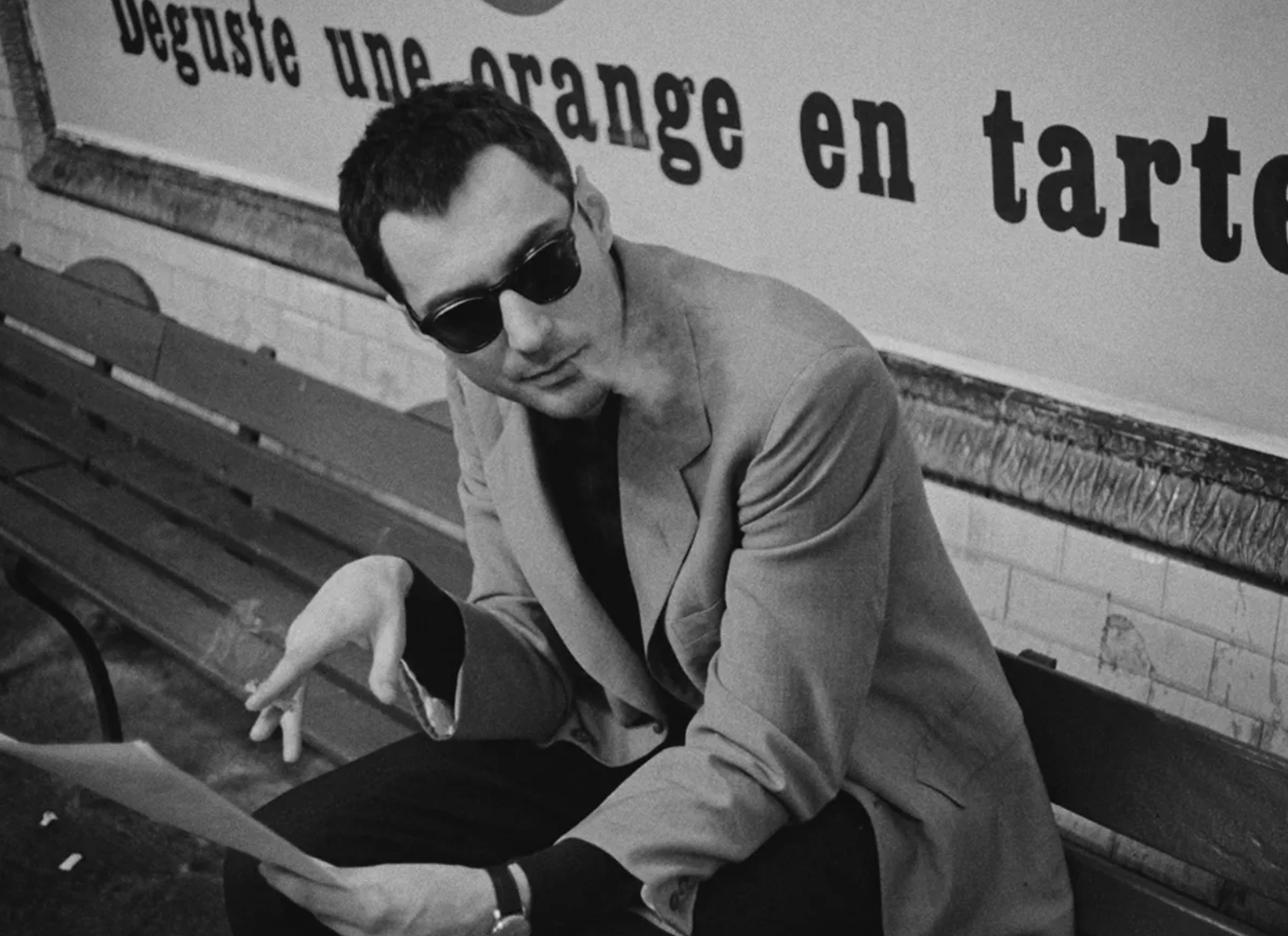
Richard Linklater’s Nouvelle Vague is both a love letter and a restrained bow to Jean-Luc Godard’s revolutionary spirit. I saw it at the Round Top Film Festival, where its black-and-white shimmer felt perfectly at home amid the festival’s thoughtful, art-loving crowd. It’s a pretty film—undeniably so—and its monochrome palette gives every frame the texture of a cherished photograph. Yet, as beautiful as it appears, it never quite reaches the daring or disorder that made Godard’s Breathless (1960) such a cinematic thunderclap.
The film follows the young Jean-Luc Godard (Guillaume Marbeck) in the late 1950s, teetering on the edge of fame as he prepares to shoot À bout de souffle. We watch him wrangle with producers, flirt with ideas, and improvise his way through a shoot that would forever change how movies were made. Linklater’s storytelling is straightforward, almost reverent—a surprising choice given the chaos and confidence of his subject. He re-creates the cigarette smoke, the café conversations, and the jittery energy of that era, but he rarely takes the leap that Godard himself would have demanded.
Zoey Deutch, as Jean Seberg, is radiant—playful and detached in the right balance—and Aubry Dullin captures the cool indifference of Jean-Paul Belmondo. Together, they evoke the charm and danger that Breathless thrived on. But where Godard’s film felt like jazz—improvised, alive, a little reckless—Linklater’s Nouvelle Vague resembles more of a tribute concert: every note correct, every beat polished, but missing that electric unpredictability.
That said, I was entertained for most of its runtime. There’s a quiet pleasure in watching a filmmaker so in love with the craft of filmmaking itself. The 35 mm photography has a velvety richness that digital can’t match, and Linklater’s affection for cinema history shines through every shot. I just wish he had borrowed a bit more of Godard’s nerve—the willingness to break rules, to jump-cut through his own structure, to surprise us.
Leaving the theater, I felt appreciative rather than exhilarated. Nouvelle Vague is a film for film lovers—an academic’s daydream brought beautifully to life. It doesn’t capture the wild freedom of the French New Wave, but it does make you want to go back and rewatch the movies that did. For me, it was a satisfying, if somewhat restrained, start to an evening at Round Top—proof that even when Linklater plays it safe, he still plays with genuine affection.