I’m not a big horror fan. There are exceptions—filmmakers who avoid lazy jump-scares and create something hauntingly memorable—but most horror movies leave me indifferent. Still, I went to see Weapons with a group of friends: three walked out raving, one firmly declared they “hate horror,” but stayed curious.
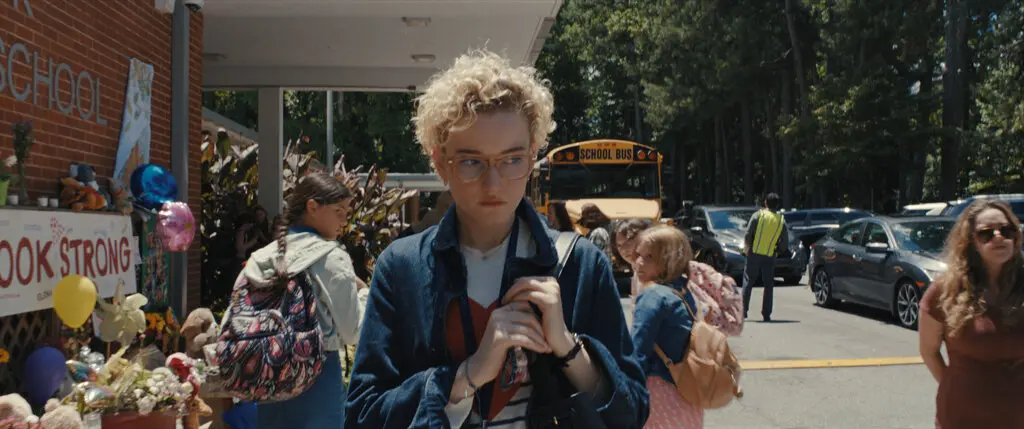
The premise is compelling: at exactly 2:17 a.m., seventeen elementary-age children rise in unison, walk into the night with outstretched arms, and disappear. No traces, no clues. The town fractures into corners of grief, fear, and suspicion—and a solitary figure appears at the center of it all: Julia Garner’s Justine Gandy, the teacher left behind with one student. Garner brings a rare, coiled energy—resentful but fragile, defiant yet crushed. She isn’t playing the “scapegoat trope”—she embodies the trope, a vessel for our collective judgment.
Zach Cregger skillfully builds this tension, with Larkin Seiple’s camera capturing every nervous glance and every shot designed to keep viewers on edge. His editing shifts perspectives like a skilled card dealer—juggling fragments of the same night until the audience feels as uncertain as the characters.
The cast elevates this even more: Josh Brolin is devastating as the grief-stricken Archer, a father who moves like broken glass—sharp and jagged; Alden Ehrenreich’s cop (and ex of Justine’s) spirals under the weight of guilt and reliance; Austin Abrams brings anxious humanity as a strained, distressed drifter drawn into the mystery.
And then there’s Cary Christopher as Alex Lilly, the only student who stays after the disappearance. His calm, wounded presence anchors the chaos around him. Christopher commands the screen with an almost unsettling stillness, his silence carrying more weight than most actors can fit into a page of dialogue. In a film that thrives on shifting perspectives, his feels the most grounded—unyielding in its quiet truth.
Cregger and Seiple often lower the camera to Alex’s level, immersing the audience in his perspective. Through his eyes, the story shifts from plot twists to the unsettling feeling of losing safety. Alexbecome s more than just a character; he symbolizes innocence under attack, serving as a thematic guide to what truly matters. His scenes, especially those with Amy Madigan, who is amazingly sinister and creepy as the unsettling Gladys, deliver some of the most spine-tingling moments in the film — not because of gore or spectacle, but because they remind us of what’s been taken and what insanity looks like..
Weapons exemplifies cinematic strength in tension—until it doesn’t. For the first two-thirds, the film challenges and unsettles; after that, it begins explaining. Where earlier sequences relied on mood and performance, the finale overwhelms with clarity and spectacle. The early chapters—a small-town spiral, each character laid bare by grief—show where Cregger’s ambition meets his control. Once answers are given, the dread lessens.
Still, I can’t deny the craftsmanship. The performances are consistently strong, the filmmaking confident, and the atmosphere unforgettable. Garner, Brolin, Ehrenreich, Abrams, and Christopher weave a web of pain, suspicion, and vulnerability that lingers even after the final frame. I liked Weapons. I admired the sheer precision of its execution and how its cast and filmmaking held the terror in the spaces between words. But by the end, I wasn’t haunted—I was satisfied. Three of my friends walked out saying they’d seen one of the year’s best horror films. One said they still hate horror. I fell somewhere in the middle—impressed, but annoyed and not convinced I need to see it again.