As a retired literature teacher who read and later introduced students to Emily Brontë’s only novel, I approached the 2026 adaptation of Wuthering Heights with anticipation—and, I admit, protectiveness. Directed and written by Emerald Fennell and starring Margot Robbie as Catherine and Jacob Elordi as Heathcliff, the adaptation is visually sumptuous and boldly acted. Yet for me, it was deeply disappointing.
Fennell’s film focuses almost exclusively on the obsessive relationship between Catherine Earnshaw and Heathcliff, largely discarding the multigenerational structure that gives Brontë’s 1847 novel its power and moral architecture. The second generation—so essential to the book’s movement toward reckoning and uneasy redemption—is effectively erased. What remains is an intense yet flattened portrait of destructive passion, stripped of the broader social and psychological consequences that ripple through the novel for decades.
The cast is undeniably strong. Margot Robbie brings volatility and physical commitment to Catherine, while Jacob Elordi portrays Heathcliff with a brooding fragility that makes him more wounded than implacable. Supporting performances from Hong Chau, Alison Oliver, Shazad Latif, Martin Clunes, and others lend weight to individual scenes. No one here lacks talent. But talent alone cannot restore what the screenplay strips away with its overtly sexualized telling. Fennell’s added elements represent a significant interpretive departure rather than a reflection of Brontë’s text.
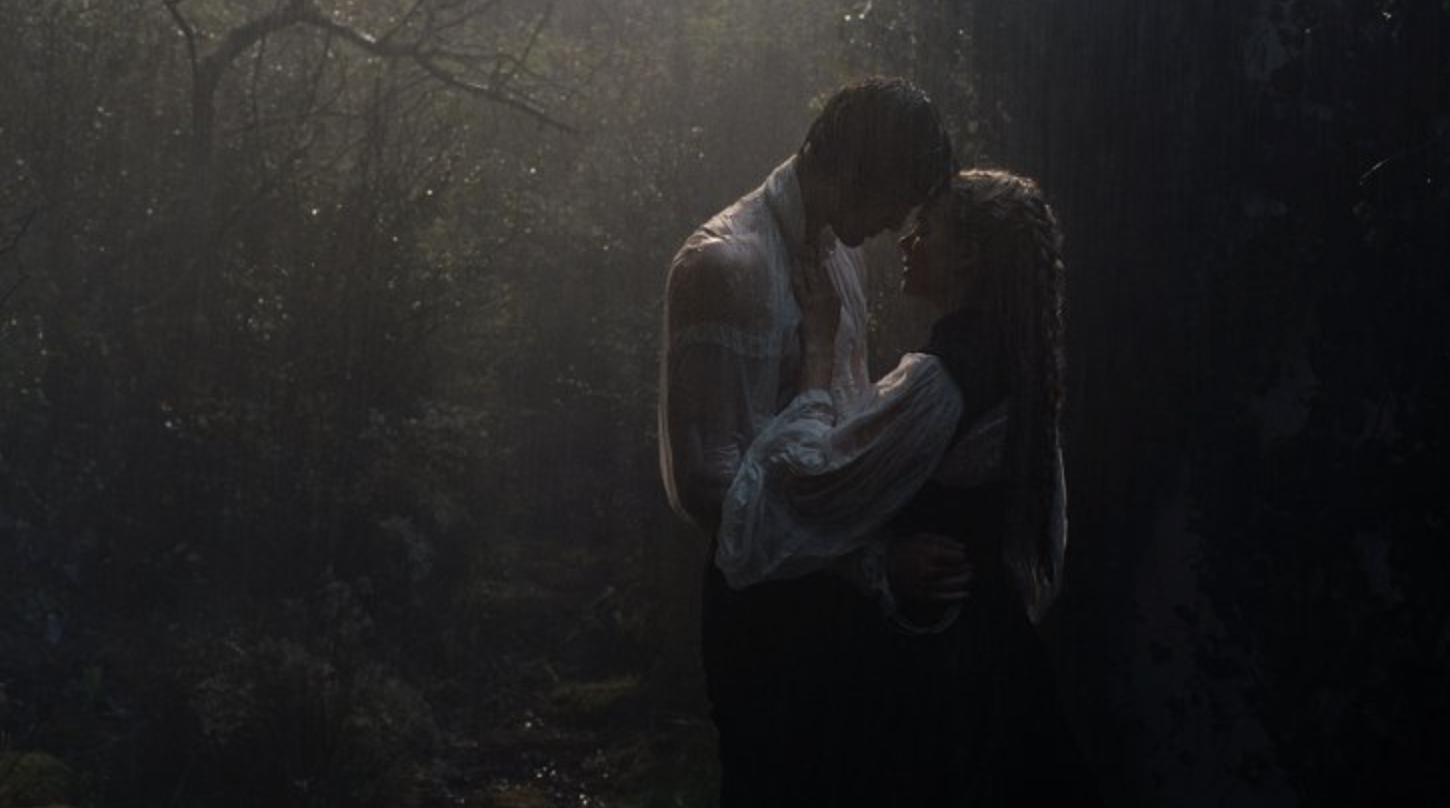
At over two and a quarter hours, the film lingers—often indulgently—on sexualized sequences that feel far more central than they were in Brontë’s text. A particularly unnecessary bondage episode struck me as gratuitous rather than illuminating. Instead of letting tension simmer through repression and longing—the very engine of the novel—Fennell opts for explicit encounters, heavy breathing, rain-soaked embraces, and prolonged, awkward stare-downs. The result is not heightened tragedy but something closer to stylized melodrama.
Having taught this novel and unpacked its layered structure and moral complexity with students, I found the film’s interpretive choices less bold than reductive. In streamlining the narrative, Fennell doesn’t so much adapt Brontë as diminish her—removing the generational framework, softening the novel’s moral severity, and thinning the intricate network of characters whose intertwined grievances and inheritances give the story its force. What remains is a sensualized fragment: heat without depth, obsession without consequence.
Heathcliff’s implacable vengeance is diluted, his motivations are simplified, and several female characters are reshaped in ways that feel diminishing rather than illuminating. By centering almost exclusively on romantic fixation, the film sidesteps the novel’s darker meditations on class, cruelty, inheritance, and the enduring cycle of harm.
And yet—here is the irony—the film is often stunning to look at. The sets are opulent and symbolically designed, ranging from the imposing stone severity of Wuthering Heights to the lavish, stylized interiors of Thrushcross Grange. The costuming is remarkable, with intricate fabrics and dramatic silhouettes that command attention. Hair and makeup are meticulously crafted, lending the production a painterly richness. In purely visual terms, it is a feast.
But spectacle cannot replace substance. Brontë’s novel is fierce, strange, and structurally daring. It spans decades and generations, refusing to romanticize the toxicity it depicts. Despite its ambition and aesthetic splendor, this adaptation reduces that complexity to a prolonged study of erotic fixation. For viewers unfamiliar with the book, it may read as a sweeping gothic romance. For those of us who have lived with the novel in the classroom and on the page, it feels like a narrowing—beautifully dressed yet severely lacking.