In 1928, Spanish poet, playwright, and theater director Federico García Lorca made a name for himself with Romancero gitano and went on to produce a respected, acclaimed body of work over the next eight years. Sadly, he became a casualty of the Spanish Civil War, as it is suspected that the Nationalist Militia assassinated him. His legacy continues to inspire art across poetry, theater, and cinema. Garcia Lorca’s works have also had a profound impact on queer art, including a new film that is guaranteed to earn critical acclaim and potential end-of-year accolades.
La Bola Negra is a remarkable film that honors and celebrates Federico Garcia Lorca’s work and his influence on generations of queer men and artists. The film features three intertwined stories of men from three different years and how they connect to Garcia Lorca’s work. The film follows Sebastian, a shy, meek musician drafted by the Nationalist forces after a bombing in his village. It is revealed eventually that Sebastian is gay, as he falls for an enemy soldier, Rafael Rodríguez Rapún, a wounded soldier held prisoner by Sebastian’s unit.
The movie also follows a young, gay man named Carlos, who, in 1937 Granada, seeks exclusive membership in a social club of which his wealthy father is a member. However, rumors of his homosexuality spread around his town and threaten both his reputation and the reputations of his family members. The next story jumps ahead to 2017, where Alberto López Azcuna, a historian and former playwright studying queer dissidence, receives word that his estranged grandfather has passed away and left him something of value as an inheritance. I will leave my synopsis at that, as the connections between these stories are best discovered by experiencing this amazing film.
Based on Garcia Lorca’s unfinished play, La Bola Negra, and Alberto Conejero’s La Piedra Oscura, writer/directors Javier Calvo and Javier Ambrossi, along with the cast and crew, have crafted a powerful and exquisite work of cinematic art. Each story is as compelling as the next, and when the connections are revealed, it is guaranteed to blow the film’s audiences away in all the best ways. These stories reflect the lives of gay people struggling with their identities during a time when they were forced to hide their true natures, thus depriving them of genuine happiness. As the more modern story unfolds, we see how the past’s struggles affect the lives of people today. Both Calvo and Ambrossi deserve high praise and respect for their outstanding storytelling and direction.
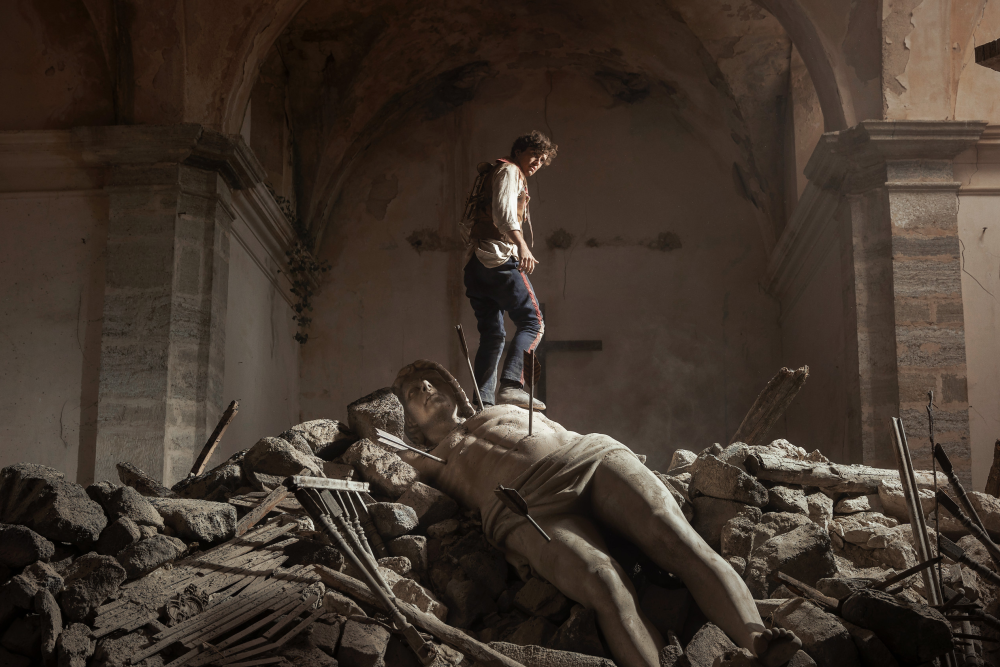
Cinematographer Gris Jordana, editor Alberto Gutiérrez, and composer Raül Refree deserve praise for their impeccable work in crafting truly gorgeous scenes. The set and costume design is also wonderful, particularly in the Spanish Civil War scenes. Aside from Christopher Nolan’s The Odyssey, everyone’s work in crafting this movie’s look makes La Bola Negra one of the most gorgeous movies I saw in the theater this year.
The entire cast is phenomenal, too. The movie stars Guitarricadelafuente as Sebastian, Carlos González as Alberto, Miguel Bernardeau as Rafael Rodríguez Rapún, and Milo Quifes as Carlos. These actors deliver transcendent performances that all contribute to the movie’s heart. The film also features wonderful turns and appearances by Lola Dueñas, Penélope Cruz, Glenn Close, and several others.
La Bola Negra is essential cinema for fans of epic arthouse features and LGBTQ audiences. It is currently getting a limited theatrical run before it lands on Netflix on December 2. If this kind of movie is totally your jam, it is a must-see in the theater. It will probably land in my top 5 movies of the year and could become my pick for best foreign-language film. We will have to see how the other nations’ offerings turn out as awards season draws near. For now, Spain leads.