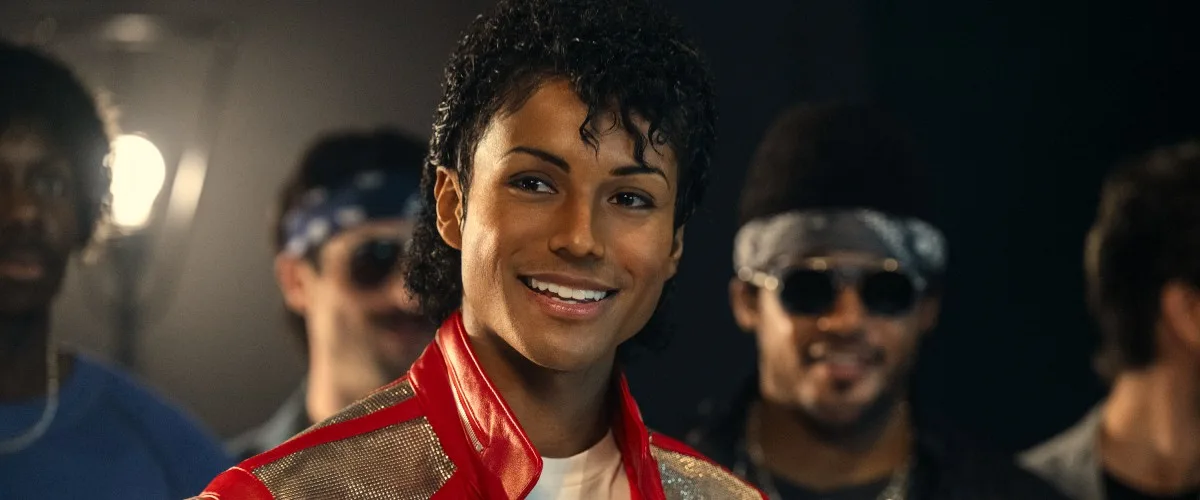
I won’t lie: I had qualms going into Antoine Fuqua’s Michael Jackson biopic. As soon as I heard a biopic was in the works, I wondered how it would turn out. Would it simply celebrate his tremendous talents, address MJ’s unusual behavior and history of parental abuse, or explore the controversies surrounding the molestation allegations and his tragic death from drug abuse? These questions were on my mind from the start.
In addition, I recently discovered that the filmmakers had to make some major changes to their movie. Originally, the producers wanted to tell a complete story, warts and all. They wanted to answer yes to all of my questions. However, revisions were required under a legal agreement between Jackson and one of the accusers. The filmmakers’ hands were tied, and they had no choice but to revise the screenplay and do reshoots to change the third act and ending of the movie. The filmmakers actually wanted to portray the troubles MJ faced after being accused of sexual abuse by multiple people.
In my view, the film feels overly sanitized, focusing solely on Michael’s rise to fame, stardom, and financial success while completely ignoring the issues that derailed his career and life. As a result, it is neither a great nor a terrible movie, but rather an incomplete portrayal.
The story begins with Jackson family patriarch, Joseph Jackson (Colman Domingo), envisioning a way out of poverty for his family in Gary, Indiana, after he discovers that five of his sons are musically talented, particularly Michael (Juliano Krue Valdi), who at such a young age has an amazing singing voice and the ability to pick up exciting dance moves. Though the Jackson boys enjoy singing, dancing, and performing, they aren’t exactly thrilled about the ways Joseph “encourages” them to persevere and succeed. However, his tenacity pays off when the Jackson 5 is noticed by the right people in the music business. They draw national and worldwide attention after signing with Motown under the guidance of mogul Berry Gordy (Larenz Tate).
Though successful as a group, the real draw of the Jackson 5 is Michael, and as he grows beyond his teenage years, he begins to question both his father’s motivations and methods, which usually involve cruel, violent punishment. As Michael (now played by Jafaar Jackson) further develops his talents as a singer, dancer, and songwriter, he realizes that the only way he can further grow as an artist is by escaping the fierce grip of Joseph.
With a screenplay by John Logan, Antoine Fuqua directs what could have been an outstanding movie. There are definitely some shades of greatness here. Fuqua and his team do a great job of recreating many of Michael’s iconic moments. As a movie about the artist’s rise, Michael deserves some high points. However, some of the choices made are bewildering and highly questionable.
I understand that the filmmakers wanted Colman Domingo to look more like Joseph Jackson, or at least closer to how he looked over the years, but the makeup team made him look rather bizarre. The makeup just looks artificial. I can also argue that the team also botched the work on actor Mike Myers, who portrays Walter Yetnikoff, the president of CBS Records during Michael’s Thriller era. It is already distracting enough, casting Myers in the role, but adding bad makeup to the mix definitely took me out of the moment.
The third act suffers from a lack of substance, as the film avoids delving into the challenges Michael faced later in his life. Instead, the final product is merely a musical revue of Michael Jackson’s music up until the Bad album, with the only central conflict being his pursuit of autonomy. Although this is compelling, the story requires deeper exploration to do justice to its subject.
Getting back to the positive aspects of this movie, I was mostly impressed by the performances of the cast, particularly those of Jafaar Jackson and Colman Domingo. Domingo is incredible and frightening as the mean, but greed-driven Joseph Jackson. Despite his terrible makeup, his performance helps elevate his presence on screen. As for Jafaar, I was blown away by how well he captures Michael Jackson’s boyish spirit, sensitivity, and passionate drive. And to top it off, the man can sing well and dance beautifully. I must also praise Nia Long’s solid performance as Michael’s loving mother and confidant, Katherine Jackson.
Now, this might be a minor spoiler, but the movie ends with the line “Michael’s story continues,” which hints that a sequel may be in the works. Again, this raises many of the same questions I had in this first installment. But given the legal constraints, I can’t imagine the producers will get clearance to tell the missing parts of Michael’s story without spending serious money. Either way, I feel that this movie was already troubled from the beginning. It is already tremendously difficult to pull off a biopic about a musical artist without falling into the overplayed tropes, cliches, and so forth. On top of these challenges, the producers just couldn’t make the movie they wanted. While I did enjoy several moments and elements of Michael, I cannot say that it is a great movie as a whole. Real fans of Michael Jackson will probably enjoy the callbacks, but the movie doesn’t exactly reveal anything deeper about the man or anything that most fans don’t already know.