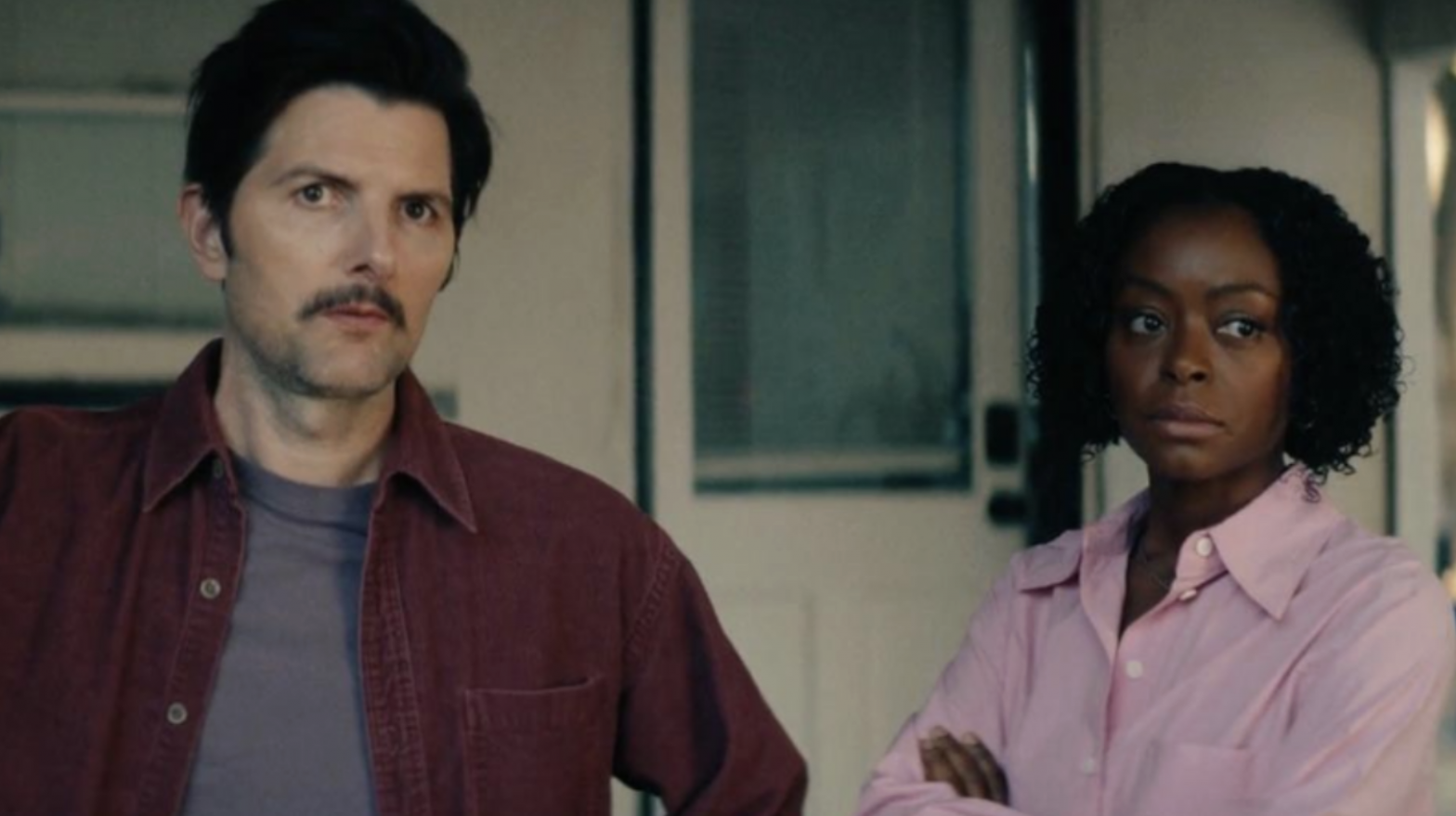
The Saviors is one of those films I wanted to like more than I did. It has a compelling setup, a strong cast, and a clear intention behind what it’s trying to say. To be fair, there were moments when it genuinely pulled me in. I found parts of the mystery engaging, even if I was a step ahead of it, which dulled some of the tension. Still, there’s something slightly off in how director Kevin Hamedani and screenwriter Travis Betz bring it all together, as if they have a clear sense of what they want to explore but can’t quite land it.
The story follows a couple on the brink of divorce—Sean (Adam Scott) and Kim (Danielle Deadwyler)—who rent out their guest house to two siblings whose presence slowly fuels suspicion and paranoia. What begins as unease gradually spirals into something much bigger and far more misguided. The idea itself is strong—there’s real potential in examining how fear and bias can distort perception—but the execution doesn’t fully support that weight. Some turns happen too quickly, especially when it comes to how certain characters shift from skepticism to full-blown accusation. That progression needed more resistance, more tension, and frankly, more realism.
That said, the performances do a lot of heavy lifting. Theo Rossi and Nazanin Boniadi, in particular, bring depth and quiet intensity that make their characters feel grounded even when the story around them wavers. You can sense there’s more beneath the surface, and they carry that throughout, keeping you invested. Other members of the cast are solid, but not always given enough to work with, which leaves some roles feeling underdeveloped or simply present without purpose.
Where the film both succeeds and stumbles is in its themes. It’s clearly trying to say something about fear, bias, and how people project danger onto those who feel unfamiliar. That intention comes through, and I appreciated it. But the way it unfolds feels uneven. There are moments that hit, where you can see exactly what the film is aiming for, followed by stretches when it seems unsure how to get there. It becomes less about building a cohesive narrative and more about circling ideas that never fully connect.
I left the SXSW 2026 screening feeling conflicted. There’s enough here to respect—the ambition, the performances, the underlying message—but also enough that didn’t work to make the overall experience frustrating. It’s intriguing in pieces, and I can see why it might resonate with some viewers, especially those who go in without trying to solve it as it unfolds. For me, though, it never quite came together in a satisfying way, and I kept wishing it had trusted its ideas enough to develop them more fully rather than rushing through them.