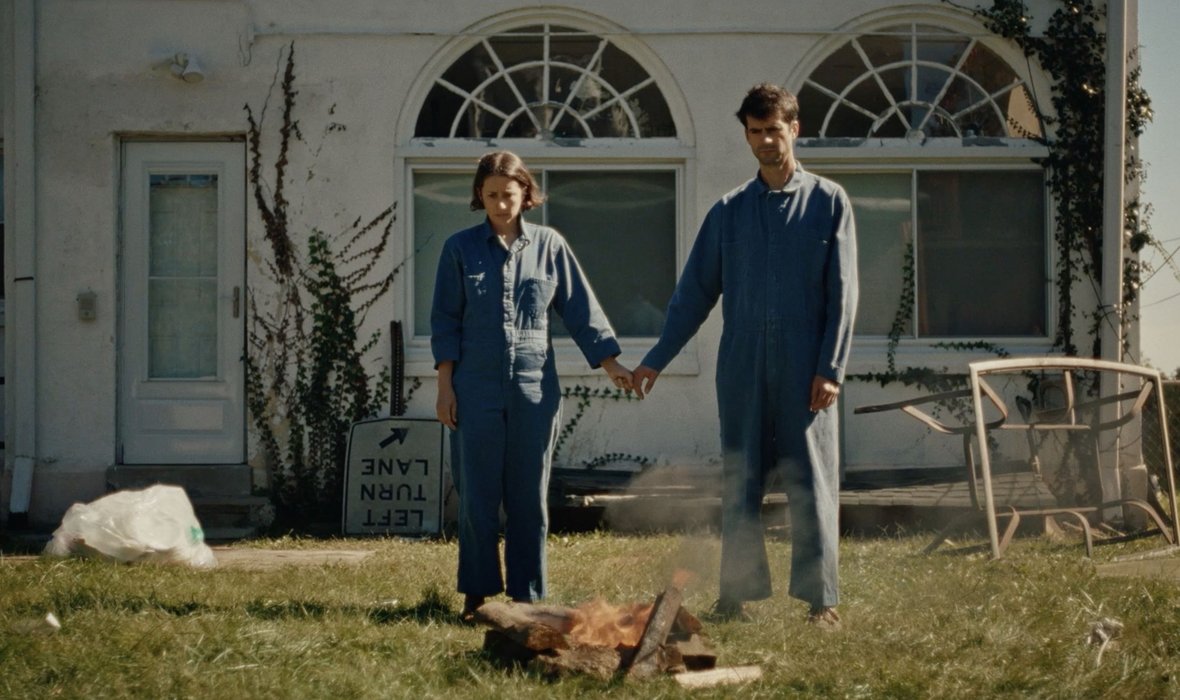
Little Doors is undeniably weird, but unlike some films that use strangeness for its own sake, this one left me thinking about what it meant. Writer-director Anthony Oberbeck sets an awkward romance in a quietly apocalyptic world, then introduces a bizarre physical mystery that upends everything. The result is funny at times, uncomfortable at others, and far more thought-provoking than its odd premise suggests.
Megan Koester plays a lonely woman living in a nearly empty house as the outside world slowly falls apart. When she hires an equally awkward locksmith, played by Oberbeck, the two gradually form a relationship built as much on shared silence and imitation as on genuine communication. Just as their strange version of domestic life begins to feel almost comfortable, she discovers a small wooden door on her side and must decide whether to open it.
Koester and Oberbeck, who are married in real life, make the unusual relationship believable because neither smooths over the characters’ discomfort. Their long pauses, uncertain expressions, and clumsy attempts at closeness create both the humor and the tension. Eleanore Pienta, Ikechukwu Ufomadu, Connor Kizer, and Frank Mosley complete the small cast, though the film belongs primarily to its central couple.
The premise is partly about how people can lose themselves in love. It also examines the things people do to prove they are in love, to convince someone else to love them, or to behave as they think people in relationships are supposed to. At times, these two appear to be creating a life together; at other times, they seem to be performing an idea of togetherness without fully understanding what either of them needs.
The little door serves as an obvious yet effective metaphor for everything people keep closed off from one another. Opening it could symbolize vulnerability, trust, or finally allowing another person access to the most private part of oneself. Yet the film also asks whether accepting another person should require changing, surrendering, or erasing part of oneself in return.
That is where Little Doors becomes more disturbing than romantic. Love can involve compromise and acceptance, but the film keeps pushing those ideas until they become uncomfortable questions about control, need, and identity. At what point does proving love become submission, and at what point does accepting someone become losing oneself?
Oberbeck never offers simple answers, and the film’s deadpan pacing will not appeal to everyone. Some scenes linger, the dialogue is deliberately stilted, and its strange logic demands patience. Still, Koester’s guarded performance gives the story an emotional center, while Oberbeck makes the locksmith both sympathetic and increasingly difficult to understand.
Little Doors is a peculiar film that will likely mean different things to different viewers. For me, its strongest idea is that the desire to love and be loved can prompt people to reveal themselves, remake themselves, or give away more of themselves than they realize. I walked out thinking it was extremely odd, but I kept thinking about it—and that may be the best measure of what the film accomplishes.