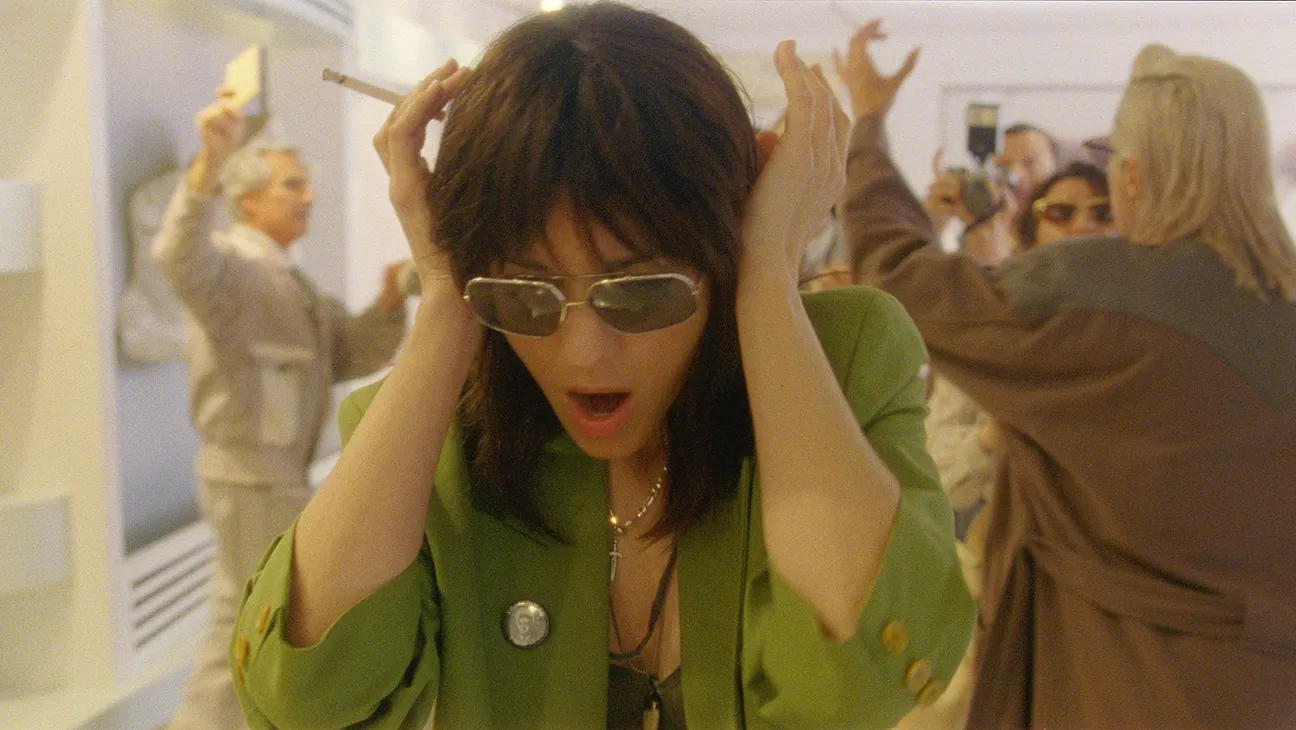
When the person introducing Roma Elastica called it a “fever dream,” my instincts told me to walk away. I should have listened. Director Bertrand Mandico’s film is so strange, disjointed, and deliberately disturbing that any meaning beneath its excesses is hard to find.
Set in 1982, the story follows Eddie (Marion Cotillard), a French actress whose American fame has faded. She travels to Rome with her loyal makeup artist, Valentina (Noémie Merlant), to star in a science-fiction film that may be her final project. Eddie is also concealing a serious illness as she tries to maintain her image and keep working.
That premise could support an interesting and moving story. Eddie is facing cancer, aging, declining fame, and an industry that too often treats actresses as disposable once they are no longer young. The film may use its bizarre world to explore her fear of death and the loss of an identity built around beauty and celebrity.
Unfortunately, Roma Elastica buries those ideas beneath an exhausting array of surreal images, grotesque encounters, sexual material, and characters who appear and disappear, failing to create a coherent narrative. Scenes often feel disconnected from what comes before or after. The film within the film also begins to merge with Eddie’s deteriorating mental and physical condition, making it increasingly difficult to determine what is real, imagined, symbolic, or included for shock value.
Marion Cotillard is why I didn’t hate the film altogether. She gives Eddie a wounded, exhausted presence that occasionally cuts through the surrounding confusion. Even when the screenplay offers little emotional grounding, Cotillard remains compelling enough to keep Eddie from disappearing into Mandico’s visual chaos.
The film is undeniably creative and visually distinctive. Its exaggerated sets, costumes, lighting, and production design create images that will be hard to forget, though several are memorable for reasons I would rather not remember. But visual imagination alone does not automatically make a film meaningful or enjoyable.
Some viewers will undoubtedly appreciate the many references to Italian cinema and interpret each disturbing image as part of a larger metaphor about mortality, fame, and filmmaking. Others may willingly surrender to the experience without needing a conventional narrative. For me, Roma Elastica was too weird, too fragmented, and too unpleasant to justify the effort required to decipher it.
The warning was there from the beginning: this was going to be a fever dream. Roma Elastica delivered exactly that, and I was more than ready to wake up. By the end, I felt my time would have been better spent in another theater—or, frankly, staring at a wall.